

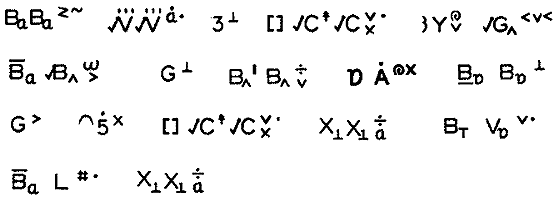
Stokoe notation
Phonemic script for sign languages
Stokoe notation ( STOH-kee) is the first phonemic script used for sign languages. It was created by William Stokoe for American Sign Language (ASL), with Latin letters and numerals used for the shapes they have in fingerspelling, and iconic glyphs to transcribe the position, movement, and orientation of the hands.
Nº Q7618587 ★
Común · Saberes
Stokoe notation
Phonemic script for sign languages
Stokoe notation ( STOH-kee) is the first phonemic script used for sign languages. It was created by William Stokoe for American Sign Language (ASL), with Latin letters and numerals used for the shapes they have in fingerspelling, and iconic glyphs to transcribe the position, movement, and orientation of the hands.
En Wikipedia
Texto en inglés Aún no hay artículo en tu idioma: extracto en inglés.
Stokoe notation ( STOH-kee) is the first phonemic script used for sign languages. It was created by William Stokoe for American Sign Language (ASL), with Latin letters and numerals used for the shapes they have in fingerspelling, and iconic glyphs to transcribe the position, movement, and orientation of the hands. It was first published as the organizing principle of Sign Language Structure: An Outline of the Visual Communication Systems of the American Deaf (1960), and later also used in A Dictionary of American Sign Language on Linguistic Principles, by Stokoe, Casterline, and Croneberg (1965). In the 1965 dictionary, signs are themselves arranged alphabetically, according to their Stokoe transcription, rather than being ordered by their English glosses as in other sign-language dictionaries. This made it the only ASL dictionary where the reader could look up a sign without first knowing how to translate it into English. The Stokoe notation was later adapted to British Sign Language (BSL) in Kyle et al. (1985) and to Australian Aboriginal sign languages in Kendon (1988). In each case the researchers modified the alphabet to accommodate phonemes not found in ASL. The Stokoe notation is mostly restricted to linguists and academics. The notation is arranged linearly on the page and can be written with a typewriter that has the proper font installed. Unlike SignWriting or the Hamburg Notation System, it is based on the Latin alphabet and is phonemic, being restricted to the symbols needed to meet the requirements of ASL (or extended to BSL, etc.) rather than accommodating all possible signs. For example, there is a single symbol for circling movement, regardless of whether the plane of the movement is horizontal or vertical.
Texto: Wikipedia en inglés, CC BY-SA 4.0. · Imagen: anon. Uploaded by Kwamikagami at en.wikipedia (Public domain) ·
Cartas cercanas
-

alfabeto osago
Alfabeto utilizado para escribir osago
Nº Q7105529 ★
Sin ofertas
-

Alfabeto
Conjunto de letras utilizadas para escribir un idioma determinado
Nº Q9779 ★★★★★
Sin ofertas
-
A
Alfabeto fonético americanista
Nº Q2075747 ★★
Sin ofertas
-
h
historia del lenguaje de señas
Aspect of history
Nº Q1188730 ★★
Sin ofertas
-

Historia del alfabeto
Acontecimientos ligados al origen y desarrollo del abecedario
Nº Q911270 ★★★
Sin ofertas
-
F
Fitch notation
Notational system for constructing formal proofs
Nº Q1142450 ★
Sin ofertas