

Uncommon · Knowledge
Pseudo-
Greek prefix: false
Pseudo- (from Greek: ψευδής, pseudḗs 'false') is a prefix used in a number of languages, often to mark something as a fake or insincere version. In English, the prefix is used on both nouns and adjectives.
From Wikipedia
Pseudo- (from Greek: ψευδής, pseudḗs 'false') is a prefix used in a number of languages, often to mark something as a fake or insincere version. In English, the prefix is used on both nouns and adjectives. It can be considered a privative prefix specifically denoting disproximation, i.e. that the resulting word refers to something that has moved away from the core meaning of the base that the prefix is added to. The meaning is the same in French and Greek, but in Greek it also attaches to other word classes such as verbs and adverbs.
Text: Wikipédia, CC BY-SA 4.0. ·
Related cards
-
P★★
Pseudoskepticism
Philosophical position
-
 ★★★
★★★
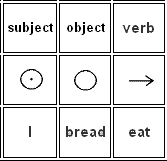
Subject–object–verb word order
Language in which the subject, object, and verb of a sentence appear or usually appear in SOV order
-
V★
Verb–subject–object word order
One in which the most typical sentences arrange their elements in that order, as in “Ate Sam oranges” (Sam ate oranges); the 3rd-most common word order among the world's languages, after SVO and SOV
-
-★★
-logy
English language suffix
-
 ★★★
★★★
Stereotype
Over-generalized belief about a particular category of people; often used in literature and films as means to emphasize characters
-
P★★★★
Postscript
Afterthought, thought of occurring after the letter has been written and signed