

Common · Knowledge
Library sort
Sorting algorithm
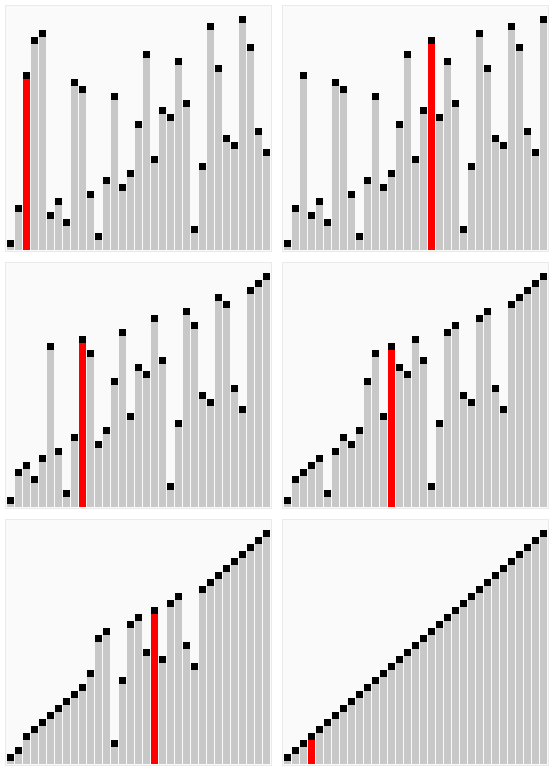
Library sort or gapped insertion sort is a sorting algorithm that uses an insertion sort, but with gaps in the array to accelerate subsequent insertions. The name comes from an analogy: Suppose a librarian were to store their books alphabetically on a long shelf, starting with the As at the left end, and continuing to the right along the shelf with no spaces between the books until the end of the Zs.
From Wikipedia
Library sort or gapped insertion sort is a sorting algorithm that uses an insertion sort, but with gaps in the array to accelerate subsequent insertions. The name comes from an analogy: Suppose a librarian were to store their books alphabetically on a long shelf, starting with the As at the left end, and continuing to the right along the shelf with no spaces between the books until the end of the Zs. If the librarian acquired a new book that belongs to the B section, once they find the correct space in the B section, they will have to move every book over, from the middle of the Bs all the way down to the Zs in order to make room for the new book. This is an insertion sort. However, if they were to leave a space after every letter, as long as there was still space after B, they would only have to move a few books to make room for the new one. This is the basic principle of the Library Sort. The algorithm was proposed by Michael A. Bender, Martín Farach-Colton, and Miguel Mosteiro in 2004 and was published in 2006. Like the insertion sort it is based on, library sort is a comparison sort; however, it was shown to have a high probability of running in O(n log n) time (comparable to quicksort), rather than an insertion sort's O(n2). There is no full implementation given in the paper, nor the exact algorithms of important parts, such as insertion and rebalancing. Further information would be needed to discuss how the efficiency of library sort compares to that of other sorting methods in reality. Compared to basic insertion sort, the drawback of library sort is that it requires extra space for the gaps. The amount and distribution...
Text: Wikipédia, CC BY-SA 4.0. ·
Related cards
-
 ★★
★★
Insertion sort
Sorting algorithm that, at each iteration, inserts the current input element into the suitable position between the already sorted elements
-
 ★
★
Bucket sort
Sorting algorithm
-
 ★★★
★★★
Bubble sort
Simple sorting algorithm
-
 ★★★
★★★
Library (computing)
Collection of non-volatile resources used by computer programs, often for software development
-
 ★★
★★
Sort (Unix)
Standard UNIX utility
-
 ★
★
Tree sort
Sorting algorithm that builds a binary search tree and then traverses the tree